
10-Day Gobi & Naiman Lakes Horse Trek
Day-by-Day Itinerary
Ulaanbaatar → Tsagaan Suvarga
We pick you up from your accommodation at 08:00 and drive south to Tsagaan Suvarga, about 470 km and 6 hours on a paved road, watching the green steppe give way to the open plains of the Middle Gobi. Tsagaan Suvarga, the 'White Stupa,' is a sheer escarpment that was once the floor of an ancient sea. Its sediments, laid down over millions of years, show as bands of white, pink, orange, and red, each color marking a different age. The formation rises more than 50 m at its highest point and runs for some 400 m, and from a distance it looks like the ruins of an ancient ghost city. Little formal geological research has been done here, but it makes a perfect overnight stop on the way from the Middle Gobi into the South Gobi. Take a hike around the site in the evening light, then spend the night nearby.
Tsagaan Suvarga → Yol Gorge
After breakfast, drive about 200 km (3 hours on a paved road) to Yol Gorge in the Gurvan Saikhan mountain range, the 'Three Beauties' that form the backbone of the South Gobi. 'Yol' means bearded vulture in Mongolian, and the gorge stretches for more than 10 km. At its narrowest point only three or four people can walk side by side, and the high rock walls shade the valley floor from direct sun, so ice formed by its small stream in winter often survives the hot summer months until mid-July. Enjoy an hour's hike through the gorge, watching for ibex, argali sheep, and vultures on the cliffs, then visit the small natural history museum at the park entrance, with its displays of local wildlife and dinosaur finds. Spend the night nearby.
Yol Gorge → Khongor Sand Dunes: Camel Ride
After breakfast, drive about 190 km (5 hours on dirt roads) to Khongor, the largest sand dune field in the Gobi Desert. The dunes stretch nearly 100 km long and 5 to 10 km wide, with crests rising 80 to 300 m above the surrounding land. On windy days, the moving sand produces a deep booming sound that carries a long way, which is why locals call them the 'Singing Sands.' A green oasis fed by the Khongor River lines their northern edge, in striking contrast to the bare sand. Today you ride Bactrian camels to explore these massive dunes, and the energetic can climb one of the crests for an unforgettable view across an endless sea of daffodil-colored sand. Spend the night near the dunes.
Khongor Sand Dunes → Bayanzag (Flaming Cliffs)
After breakfast, drive about 150 km (4 hours on dirt roads) to Bayanzag. American zoologist and explorer Roy Chapman Andrews named this place the 'Flaming Cliffs' during his Central Asiatic Expeditions of the 1920s, and many important dinosaur finds were made here, including Protoceratops skeletons and the first dinosaur eggs ever discovered. The Mongolian name refers to the saxaul, the hardy desert shrub that grows in thickets around the site. The red sandstone cliffs are imposing from a distance and glow especially fiery in the light of the setting sun. Walk around the site and along the cliff edge in the evening, then spend the night nearby.
Bayanzag → Ongi Monastery Ruins
After breakfast, drive about 155 km (4 hours on dirt roads) north to the ruins of Ongi Monastery on the banks of the Ongi River. Founded in 1760, it was once one of the largest monasteries in the Gobi, home to temples on both sides of the river, until it was destroyed in the communist purges of 1937. The raw violence of that destruction is still visible and palpable across the site today. Hike among the ruins, visit the small local ger museum displaying objects that survived the destruction, and step inside the small, lovely, and active Buddhist temple that has been rebuilt here. Spend the night nearby.
Ongi → Arvaikheer → Naiman Lakes
Today is a full day on the road as the desert gives way to the mountains. After breakfast, drive about 140 km (3 hours on dirt roads) to Arvaikheer, the provincial center of Uvurkhangai province, for lunch. In the afternoon, continue about 115 km (3 hours on dirt roads) up into the Khangai Mountains to the Naiman Lakes, whose name means 'Eight Lakes.' The area holds eight striking lakes of varying colors, set in volcanic craters high in the mountains. Shireet Lake is the largest and the southernmost of them. Remote and very picturesque, the area is a favorite with trekkers, and the view of the Khangai Mountains and lakes from the Shireet mountain pass is one of the most beautiful in Mongolia. Tonight you stay with a nomadic family in a traditional ger.
Naiman Lakes: Horse Trek
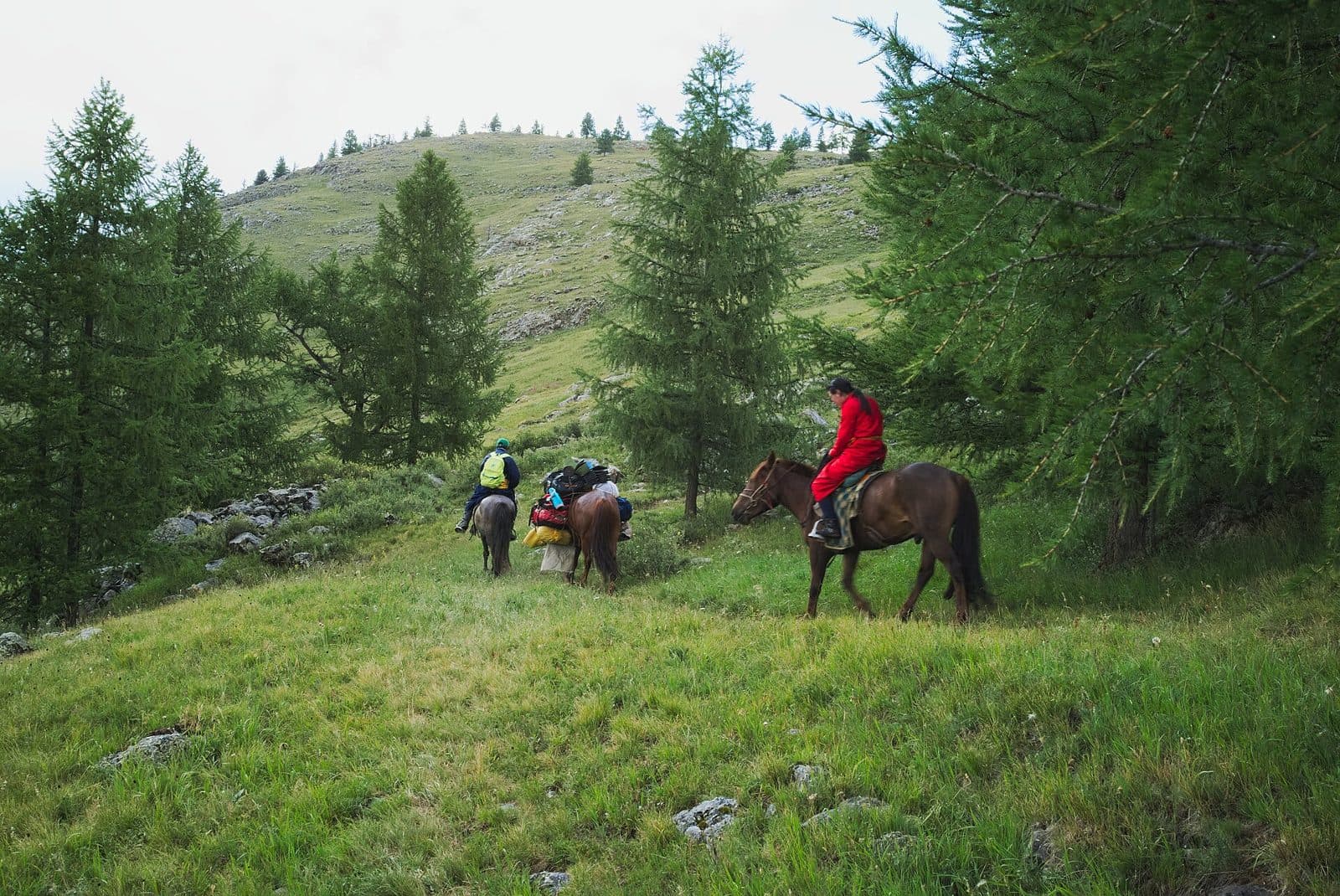
After breakfast, mount up for a full day's horse trek. Mongolian horses are small, sturdy, and sure-footed, the same breed that carried the legendary Mongol warriors across Eurasia, and they are perfectly at home in this terrain. The route leads through timbered ridges and wildflower-dotted mountain meadows, deep into a wilderness that is only reachable on horseback or on foot. Your horsemen lead the way and look after the horses, and pack horses carry the camping gear, so you can simply enjoy the ride, the silence, and the wide Khangai views. In the evening, camp out in tents in the mountains.
Horse Trek → Orkhon Waterfall
After breakfast, continue the horse trek for another full day, riding down to Orkhon Waterfall. More than 25 m high and 10 m wide, it is the biggest waterfall in the country and one of the most beautiful sights of the Orkhon Valley, a UNESCO World Heritage site. The land around it was shaped by volcanic eruptions about 20,000 years ago and lies under a lava layer more than 10 m thick, through which the Ulaan River has carved the gorge that the falls plunge into. Say goodbye to your horses and horsemen, and after dinner take a refreshing walk to the falls. You'll hear it before you see it, as the sound of tumbling water fills the valley.
Orkhon Waterfall → Tuvkhun Temple → Karakorum
After breakfast, drive about 60 km (2 hours on dirt roads) to Tuvkhun Temple, set on the peak of densely forested Shiveet Mountain at an elevation of about 2,000 m. Followers of Zanabazar, the first Bogd (head of Mongolian Buddhism) and a celebrated sculptor, built the temple in 1653 as a retreat for meditation and an art studio. There is plenty to see: meditation caves, Zanabazar's footprint in the rock, and the spot where he is said to have first drawn the Soyombo, the symbol of Mongolian independence. Hike up from the foot of the mountain to the monastery at the top. After lunch, drive about 110 km (2 hours, mostly on dirt roads) to Karakorum, the capital of the Great Mongol Empire, where a small township stands today. Some 200 years after the city was sacked by Chinese armies, builders reused materials from its ruins to found Erdene Zuu in 1586, the first Buddhist monastery in Mongolia. Spend the night nearby.
Karakorum → Ulaanbaatar
After breakfast, explore Karakorum. First visit Erdene Zuu Monastery, ringed by a wall topped with 108 white stupas, whose temples still hold fine Buddhist statues, paintings, and masks. Then tour the Karakorum Museum, where finds from the imperial capital and a model of the city show what it looked like in the days of the Mongol khans, and see other historical sights around the town, such as the ancient stone Turtle Rock. After lunch, drive back to Ulaanbaatar, about 360 km and 6 hours on a paved road, and we transfer you to your accommodation, arriving at around 19:00.