
11-Day Gobi, Orkhon & White Lake Grand Loop
Day-by-Day Itinerary
Ulaanbaatar → Tsagaan Suvarga
We pick you up from your accommodation at 08:00 and drive south to Tsagaan Suvarga, about 470 km and 6 hours on a paved road, watching the green steppe give way to the open plains of the Middle Gobi. Tsagaan Suvarga, the 'White Stupa,' is a sheer escarpment that was once the floor of an ancient sea. Its sediments, laid down over millions of years, show as bands of white, pink, orange, and red, each color marking a different age. The formation rises more than 50 m at its highest point and runs for some 400 m, looking like the ruins of an ancient ghost city from a distance. It is also a natural place to break the long journey from the Middle Gobi to the South Gobi. Take a hike around the cliffs in the evening light, then spend the night nearby.
Tsagaan Suvarga → Yol Gorge: Hike
After breakfast, drive about 200 km (3 hours on a paved road) to Yol Gorge in the Gurvan Saikhan mountain range. 'Yol' means bearded vulture in Mongolian, and the gorge stretches for more than 10 km. At its narrowest point only three or four people can walk side by side, and the high rock walls shade the valley floor from direct sun, so ice formed by its small stream in winter often survives through the hot summer months until mid-July. Enjoy an hour's hike through the gorge, keeping watch for ibex and vultures on the cliffs above, and visit the small natural history museum at the park entrance, with its displays of local wildlife and fossils. Spend the night near the gorge.
Yol Gorge → Khongor Sand Dunes: Camel Ride
After breakfast, drive about 190 km (5 hours on dirt roads) to Khongor, the largest sand dune field in the Gobi Desert. The dunes stretch nearly 100 km long and 5 to 10 km wide, with crests rising 80 to 300 m above the surrounding land. On windy days, the moving sand produces a deep booming sound that carries a long way, which is why locals call them the 'Singing Sands.' A green oasis fed by the Khongor River lines their northern edge, a striking contrast to the golden sand. Today you ride Bactrian camels to explore the dunes, and the energetic can climb one of the crests for an unforgettable view across a sea of daffodil-colored sand. Spend the night near the dunes.
Khongor Sand Dunes → Bayanzag (Flaming Cliffs)
After breakfast, drive about 150 km (4 hours on dirt roads) to Bayanzag. American explorer Roy Chapman Andrews named this place the 'Flaming Cliffs' during his Central Asiatic Expeditions of the 1920s, and many important dinosaur finds, including Protoceratops skeletons and the first dinosaur eggs ever discovered, were made here. Fossils still weather out of the soft sandstone today, and the area remains an active site for paleontologists. The red cliffs are imposing from a distance and glow especially fiery in the light of the setting sun. Walk around the site and along the cliff edge in the evening, then spend the night nearby.
Bayanzag → Ongi Monastery Ruins
After breakfast, drive about 155 km (4 hours on dirt roads) north to the ruins of Ongi Monastery on the banks of the Ongi River. Founded in 1760, it was once one of the largest monasteries in the Gobi Desert, with temples on both sides of the river and hundreds of resident monks, until it was destroyed in the communist purges of 1937. The raw violence of that destruction is still visible and palpable across the site today. Hike among the ruins, visit the small local ger museum displaying objects saved from the monastery, and step inside the small, lovely, and active Buddhist temple that has been rebuilt here. Spend the night near the river.
Ongi → Nomadic Family → Karakorum
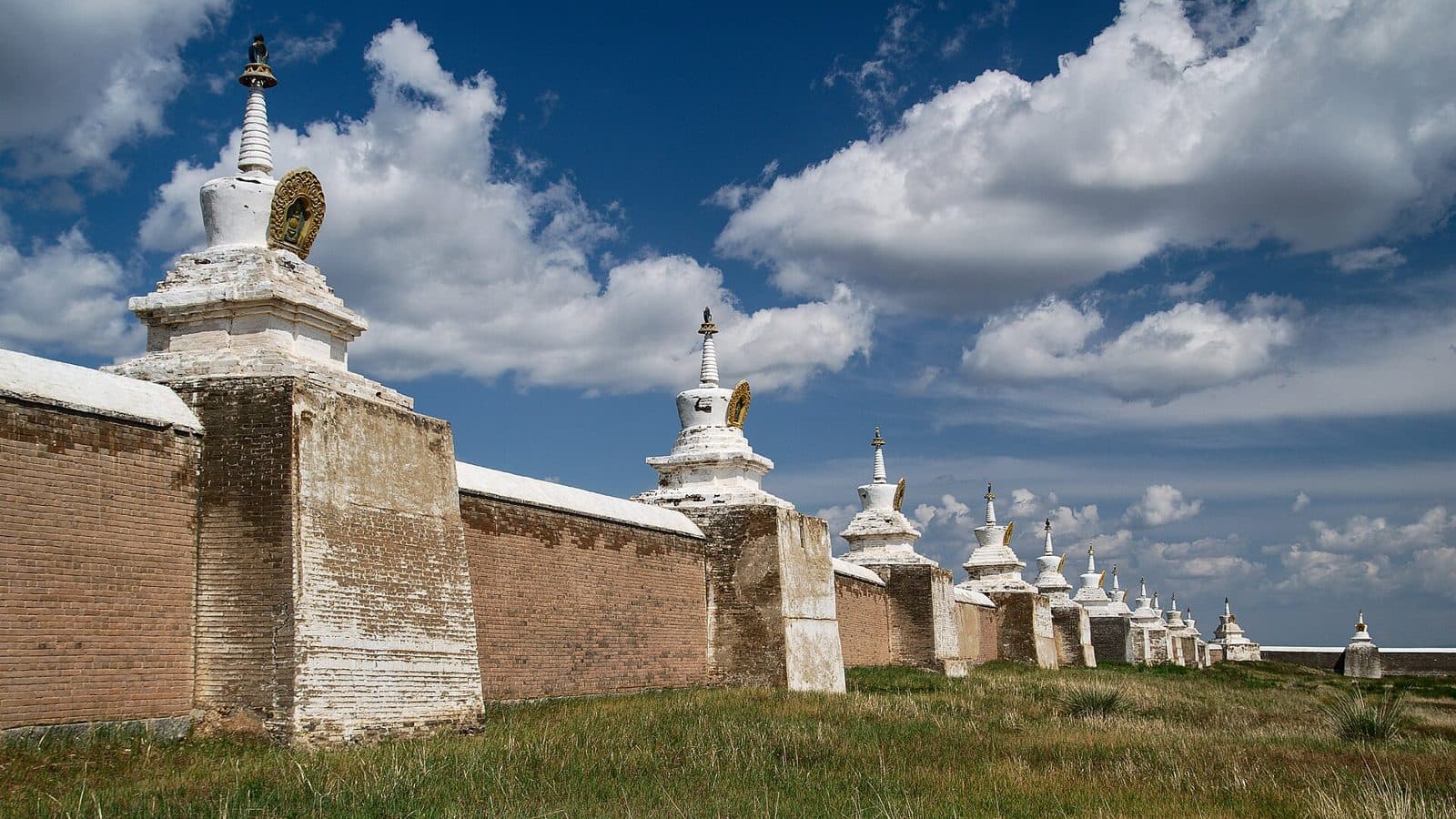
After breakfast, drive about 200 km (5 hours on dirt roads) to a nomadic herding family. Enjoy their warm, joyful hospitality and learn how the nomads live by taking every chance to join in their daily activities, from tending the livestock to helping around the ger. Then continue about 40 km (1 hour, mostly on a paved road) to Karakorum, the capital of the Great Mongol Empire, where a small township stands today. Chinggis Khaan chose the site in 1220, and under his son Ögedei it became a cosmopolitan city visited by envoys from Europe and Asia. Some two centuries after the city was sacked, builders reused materials from its ruins to found Erdene Zuu Monastery in 1586, the first Buddhist monastery in Mongolia, ringed by a wall topped with 108 white stupas. Visit Erdene Zuu, the Karakorum Museum, and the other historical sights around the town, including the granite Turtle Rock.
Karakorum → Tuvkhun Temple → Orkhon Waterfall
After breakfast, drive about 110 km (2 hours, mostly on a paved road) to Tuvkhun Temple, perched at about 2,000 m on the summit of Shiveet, a densely forested and picturesque mountain. It was built in 1653 by followers of Zanabazar, the first Bogd, or head of Mongolian Buddhism, as a place for meditation and an art studio. Among the things to see are meditation caves, Zanabazar's footprint in the rock, and the first drawn version of the Soyombo, the symbol of Mongolian independence. Hike from the foot of the mountain up to the temple (about 2 hours). After lunch, drive about 60 km (2 hours on dirt roads) to Orkhon Waterfall. More than 25 m high and 10 m wide, it is the biggest waterfall in the country and one of the most beautiful sights of the Orkhon Valley, a UNESCO World Heritage site. The land around it was shaped by volcanic eruptions about 20,000 years ago and lies under a lava layer more than 10 m thick. After dinner, take a refreshing walk to the falls. You'll hear it before you see it.
Orkhon Waterfall → Tsenkher Hot Springs: Horse Ride & Relax
After breakfast, drive about 115 km (3 hours on dirt roads) to Tsenkher Hot Springs, the most famous hot spring in Mongolia and one of Central Mongolia's most popular attractions. Its mineral-rich water comes out of the ground at a perfect 36–40°C, and the valley around it is lined with forested slopes. Tsenkher has become so popular that it can be busy in high season. After lunch, set off on a 2-hour horse ride through the valley and up the mountain for a view over the sights and sounds of nature. No riding experience is required, and Mongolian horses are small, sturdy, and sure-footed. In the evening, relax in the open-air hot spring pool of your tourist ger camp, where you spend the night on both options.
Tsenkher → Khorgo-Terkh National Park
After breakfast, drive about 215 km (4 hours, mostly on a paved road) to Khorgo-Terkh National Park. Khorgo erupted in the Quaternary Period, and its lava blocked the course of a river. The result of that meeting is a truly incredible landscape: the extinct Khorgo volcano and Terkhiin Tsagaan Lake, a large, placid lake ringed by sandy beaches at more than 2,000 m above sea level. The park holds a number of small and large circuit gorges, such as Shar Nokhoin Tam and the Solo Person's Cave, along with 13 fully or partly erupted volcanoes and rock formations cut by fast-flowing rivers and cascades. Climb to the top of the volcano for a superb panoramic view over the crater and the lava field, then walk out to discover the gorges. Spend the night near the lake.
Khorgo-Terkh → Khushuu Tsaidam Monuments → Ugii Lake
After breakfast, drive about 335 km (5 hours on a paved road) to the Khushuu Tsaidam Monuments in the Orkhon Valley. These two memorial stone installations were erected by the Turkic people in the early 8th century, in honor of the Turkic ruler Bilge Khagan and his brother, the general Kul Tegin. Their inscriptions in the Old Turkic script are among the oldest known texts in a Turkic language. Visit the local museum, which displays unique and ancient exhibits found at the site. Then drive about 40 km (1 hour on dirt roads) to Ugii Lake, a small, picturesque lake known as a paradise for fishermen. It covers only 27 km², with an average depth of 6.64 m, a deepest point of over 15 m, and a shoreline of 23 km, and it draws many water birds. In the afternoon, enjoy some boating and try your hand at fishing. Spend the night by the lake.
Ugii Lake → Khustai National Park → Ulaanbaatar
After breakfast, drive about 265 km (5 hours on a paved road) to Khustai National Park, where takhi wild horses have been reintroduced since 1992. Known in the West as Przewalski's horse, the takhi is the last wild horse subspecies to survive into the 21st century. Russian explorer N. M. Przhevalsky first described it in western Mongolia in the late 1870s, but it later died out in the wild and survived only in zoos, until breeding programs brought it back to the Mongolian steppe. Spend some leisurely time hiking in the surrounding hills to look for the wild horses, and with luck you may also spot maral deer and other animals. Then drive about 105 km (2 hours on a paved road) to Ulaanbaatar, where we drop you at your accommodation at around 19:00.