
11-Day Gobi Expedition: Khermen Tsav to Karakorum
Day-by-Day Itinerary
Ulaanbaatar → Dalanzadgad → Yol Gorge → Bayanzag
We pick you up from your accommodation and transfer you to the airport for the 1-hour flight to Dalanzadgad, the capital of the South Gobi province. On landing, your guide and driver meet you and drive about 50 km (1 hour on a paved road) to Yol Gorge in the Gurvan Saikhan mountain range. 'Yol' means bearded vulture in Mongolian, and the gorge stretches for more than 10 km. At its narrowest point only three or four people can walk side by side, and the high rock walls shade the valley floor from direct sun, so ice formed by its small stream in winter often survives until mid-July. Enjoy an hour's hike through the gorge and visit the small natural history museum. After lunch, drive about 100 km (2 hours on dirt roads) to Bayanzag, which Roy Chapman Andrews named the 'Flaming Cliffs' in the 1920s. The first dinosaur eggs ever discovered and many Protoceratops skeletons were found here, and the red cliffs glow especially fiery at sunset. Walk around the site, then spend the night nearby.
Bayanzag → Khongor Sand Dunes: Camel Ride
After breakfast, drive about 150 km (4 hours on dirt roads) to Khongor, the largest sand dune field in the Gobi Desert. The dunes stretch nearly 100 km long and 5 to 10 km wide, with crests rising 80 to 300 m above the surrounding land. On windy days, the moving sand produces a deep booming sound that carries a long way, which is why locals call them the 'Singing Sands.' A green oasis fed by the Khongor River lines their northern edge. Today you ride Bactrian camels to explore the dunes, and the energetic can climb one of the crests for an unforgettable view across an endless sea of daffodil-colored sand. Spend the night near the dunes.
Khongor → Nemegt Formation
After breakfast, leave the tourist trail behind and drive about 160 km (5 hours on dirt roads) west to the Nemegt Formation, a natural wonder protected by the state. These eroded badlands of red and ochre sandstone are among the richest dinosaur sites in the world: international expeditions since the 1940s have unearthed the giant predator Tarbosaurus, long-necked sauropods, and the bizarre, long-armed Deinocheirus here. Fossilized bones and fragments still weather out of the ground, and some can be seen protruding from the surface of the land as you walk through the valley. Please remember that all fossils are protected and must be left where they lie. Tonight is your first night of camping, under the vast, star-filled Gobi sky.
Naran Daats Spring & Zulganai Oasis
After breakfast, drive about 60 km (2 hours on dirt roads) to the Naran Daats oasis and its spring, a rare source of water in this arid land. Walk around the spring, enjoy the green meadow it feeds, and relax in the deep silence of the desert. After lunch, drive about 40 km (2 hours on dirt roads) to Zulganai Oasis, a typical Gobi oasis whose lush green carpet of shrubs and grassland sits in stark contrast to the barren hills behind it. Oases like these are lifelines for the herders, camels, and wildlife of the western Gobi, and they draw birds from far around. Walk through the oasis and explore it, then camp nearby.
Zulganai Oasis → Khermen Tsav Canyon
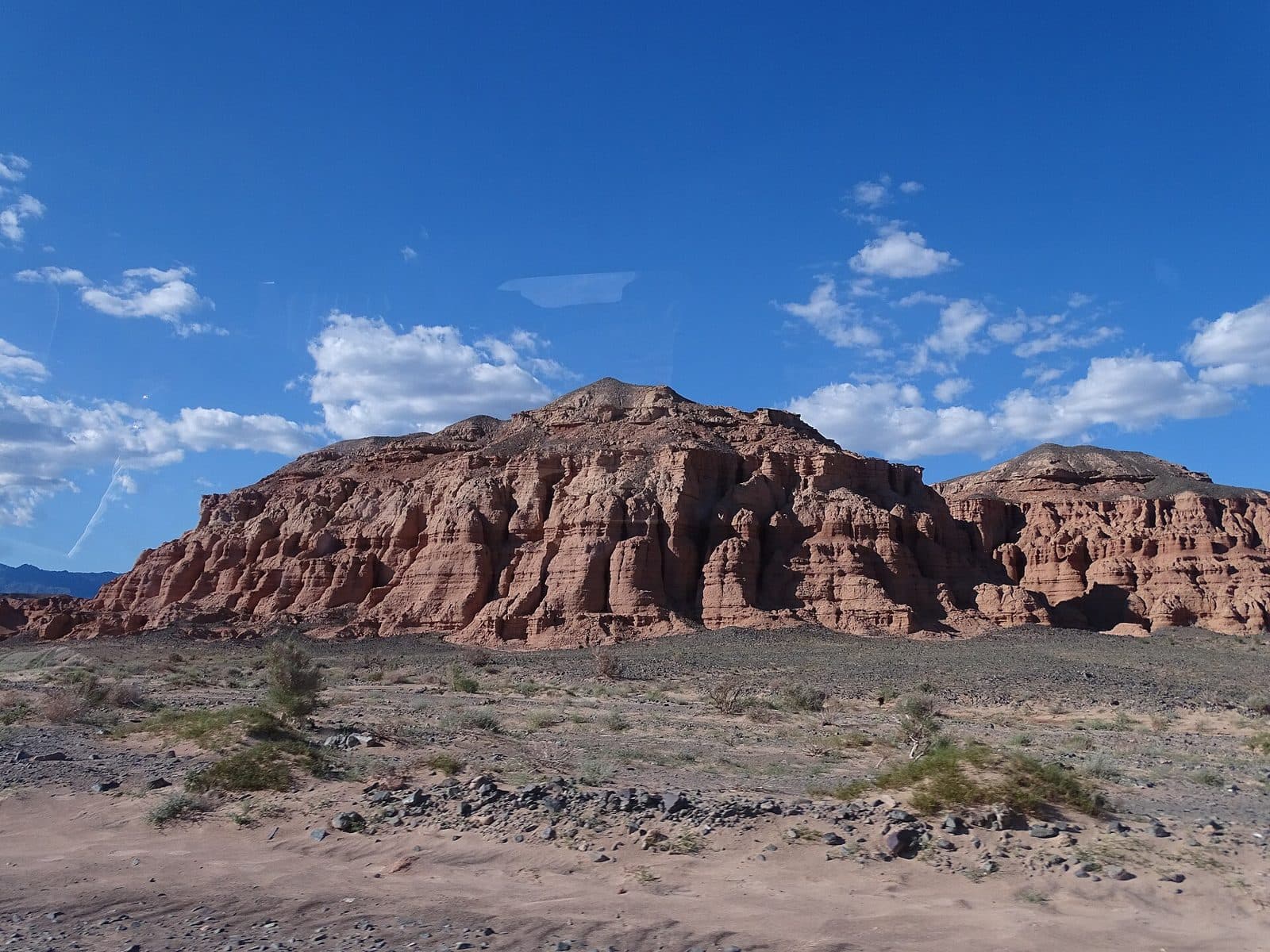
After breakfast, drive about 40 km (1 hour on dirt roads) to Khermen Tsav, the most famous canyon in the Gobi Desert. Its name combines the Mongolian words for 'citadel' and 'crack,' and from its rim you can see why: towering walls of red, orange, and white rock rise like the ramparts of a ruined fortress. Formed over thousands of years by water and wind erosion, this deep, legendary canyon is a geological museum of epic proportions, laying bare millions of years of the earth's history in its colorful layers, and it has also yielded important dinosaur and fossil finds. Walk around the canyon and explore the site, then camp overnight among its dramatic formations.
Khermen Tsav: Free Day
After breakfast, enjoy a free day at Khermen Tsav. Explore the canyon's maze of side valleys at your own pace, climb to a viewpoint on the rim, photograph the shifting colors of the cliffs as the light changes, or simply relax at camp and soak up the remoteness of one of the wildest places in Mongolia. Depending on conditions and the group's wishes, we may also use part of the day to drive on toward the next destination. Spend another night camping under the stars.
Khermen Tsav → Bichigt Petroglyphs
After breakfast, drive about 150 km (4 hours on dirt roads) to the Bichigt Petroglyphs, situated on Bayan Hill. This is one of the world's great collections of prehistoric rock art, and the largest complex of rock drawings in Asia: about 1,000 petroglyphs carved on hundreds of exposed rocks over a period of some 5,000 years, from about 3000 BCE to the 8th century. They were made by the Hunnu (Xiongnu) and other tribes of the nomadic empires, and depict themes of animal husbandry, travel, war, and magic. Cosmological, figurative, and map-like motifs appear, and in some places they combine into monumental hunting and ritual scenes. Wander among the rocks to find ibex, deer, hunters, and horsemen, then camp nearby.
Bichigt → Tsagaan Cave
After breakfast, drive about 100 km (3 hours on dirt roads) to Tsagaan Agui, the 'White Cave.' Discovered to be an archaeological site in 1996, it housed Stone Age people some 700,000 years ago and has since been the site of numerous digs, making it one of the oldest known places of human habitation in Mongolia. The cave is formed in white crystalline limestone, and inside you will find two human-sized sculptures in its chambers. Explore the cave with your guide and imagine life here in the Stone Age. In the evening, have dinner and camp overnight near Tsakhir Mountain.
Tsagaan Cave → Arvaikheer
After breakfast, drive about 210 km (5 hours, mostly on dirt roads) north to Arvaikheer, the provincial center of Uvurkhangai province. As you leave the desert behind, the landscape slowly turns greener, with more herds and gers dotting the steppe on the edge of the Khangai Mountains. After six nights of camping, enjoy a hot shower and a comfortable bed tonight in a local hotel, and stretch your legs with a stroll around this small provincial town.
Arvaikheer → Karakorum (Kharkhorin)
After breakfast, drive about 130 km (3 hours, mostly on a paved road) to Karakorum, the capital of the Great Mongol Empire, where a small township stands today. Founded under Chinggis Khaan and built up by his son Ögedei, it was once a cosmopolitan city of merchants, envoys, and craftsmen from across Eurasia. Some 200 years after it was sacked by Chinese armies, builders reused materials from its ruins to found Erdene Zuu in 1586, the first Buddhist monastery in Mongolia, ringed by a wall topped with 108 white stupas. Visit Erdene Zuu Monastery, the Karakorum Museum with its model of the imperial city, and the other historical sights around the town, such as the ancient Turtle Rock.
Karakorum → Khustai National Park → Ulaanbaatar
After breakfast, drive about 270 km (5 hours on a paved road) to Khustai National Park, where takhi wild horses have been reintroduced since 1992. Known in the West as Przewalski's horse, the takhi is the last wild horse subspecies to survive into the 21st century. Russian explorer N. M. Przhevalsky first described it in western Mongolia in the late 1870s, but it later died out in the wild and survived only in zoos, until breeding programs brought it back to the Mongolian steppe. Spend some time hiking in the surrounding hills to look for the wild horses, and with luck you may also see maral (red) deer and other animals. Then drive about 90 km (2 hours on a paved road) to Ulaanbaatar, arriving at your accommodation at around 19:00.