
16-Day Grand Mongolia Overland: Gobi to Khuvsgul
Day-by-Day Itinerary
Ulaanbaatar → Baga Gazar Rocks
We pick you up from your accommodation at 09:00 and drive south to Baga Gazar Rocks, about 250 km and 5 hours on a paved road. Rising out of the flat Middle Gobi plateau, Baga Gazar is a distinctive granite massif whose highest point stands at 1,765 m above sea level. Wind and weather have carved its rock into rounded domes, towers, and hollows that make for rewarding walks. This afternoon you hike and explore its most interesting corners: Sudut Mouth, a narrow mountain pass shaded by aspen trees, with the ruins of a Buddhist temple nearby; Jargalant Cave; and a small mineral spring that locals say is good for the eyes. As the sun goes down, the granite glows warm against the open steppe. Spend the night nearby.
Baga Gazar → Tsagaan Suvarga
After breakfast, drive about 265 km (4 hours on a paved road) to Tsagaan Suvarga, the classic overnight stop on the way from the Middle Gobi to the South Gobi. This sheer escarpment was once the floor of an ancient sea. Its layered sediments, laid down over millions of years, show as bands of white, pink, orange, and red, each color marking a different age. The cliffs rise more than 50 m at their highest point and run for some 400 m, looking like the ruins of an ancient ghost city from a distance. No precise geological dating of the formation has yet been published, which only adds to its mystery. Take a hike around the site in the evening light, when the colors are at their richest, then spend the night nearby.
Tsagaan Suvarga → Yol Gorge
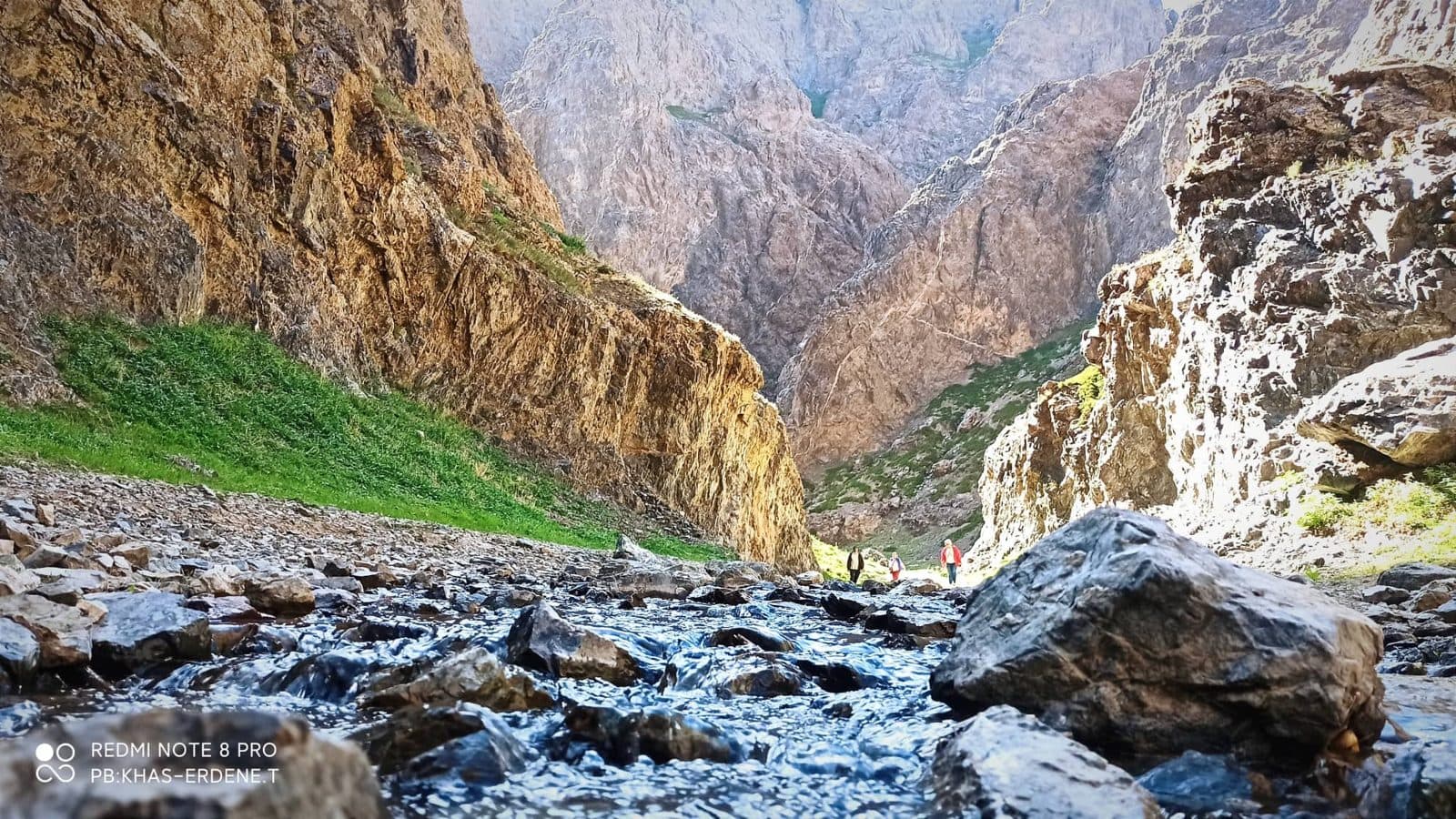
After breakfast, drive about 200 km (3 hours on a paved road) to Yol Gorge in the Gurvan Saikhan mountain range. 'Yol' means bearded vulture in Mongolian, and the gorge stretches for more than 10 km. At its narrowest point only three or four people can walk side by side, and the high rock walls shade the valley floor from direct sun, so ice formed by its small stream in winter often survives until mid-July. Enjoy an hour's hike through the gorge, watch for ibex and vultures on the cliffs above, and visit the small natural history museum at the park entrance, with its displays of local wildlife, plants, and dinosaur finds. Spend the night nearby.
Yol Gorge → Khongor Sand Dunes: Camel Ride
After breakfast, drive about 190 km (5 hours on dirt roads) to Khongor, the largest sand dune field in the Gobi Desert. The dunes stretch nearly 100 km long and 5 to 10 km wide, with crests rising 80 to 300 m above the surrounding land. On windy days, the moving sand produces a deep booming sound that carries a long way, which is why locals call them the 'Singing Sands.' A green oasis fed by the Khongor River lines their northern edge, a striking strip of meadow against the golden sand. Today you ride Bactrian camels to explore the dunes, and the energetic can climb one of the crests for an unforgettable view across a sea of sand. Spend the night near the dunes.
Khongor Sand Dunes → Bayanzag (Flaming Cliffs)
After breakfast, drive about 150 km (4 hours on dirt roads) to Bayanzag. American explorer Roy Chapman Andrews named this place the 'Flaming Cliffs' during his Central Asiatic Expeditions in the 1920s, and many important dinosaur finds, including Protoceratops skeletons and the first dinosaur eggs ever discovered, were made here. Fossils of Velociraptor and early mammals have also come out of these Late Cretaceous sandstones. The red cliffs are imposing from a distance and glow especially fiery in the light of the setting sun. Walk around the site and along the cliff edge, then spend the night nearby.
Bayanzag → Ongi Monastery Ruins
After breakfast, drive about 155 km (4 hours on dirt roads) north to the ruins of Ongi Monastery on the banks of the Ongi River. Founded in 1760, it was once one of the largest monasteries in the Gobi, home to hundreds of monks across its temples and colleges, until it was destroyed in the communist purges of 1937. The raw violence of that destruction is still visible across the site today. Hike among the ruins, visit the small local ger museum displaying objects saved from the monastery, and step inside the small, active Buddhist temple that has been rebuilt here. Spend the night near the river.
Ongi → Nomadic Family → Karakorum (Kharkhorin)
After breakfast, drive about 200 km (5 hours on dirt roads) to a nomadic family. Enjoy their warm, joyful atmosphere and learn about the clever ways nomads live by taking every chance to join in with daily herding life, just like a nomad. Then drive about 40 km (1 hour, mostly on a paved road) to Karakorum, the capital of the Great Mongol Empire in the 13th century, where a small township stands today. Some 200 years after the city was sacked, builders reused materials from its ruins to found Erdene Zuu Monastery in 1586, the first Buddhist monastery in Mongolia, ringed by a wall topped with 108 white stupas. Visit Erdene Zuu, the Karakorum Museum, and the other historical sights around the town, then spend the night in Karakorum.
Karakorum → Tuvkhun Temple → Orkhon Waterfall
After breakfast, drive about 110 km (2 hours, mostly on a paved road) to Tuvkhun Temple, perched at 2,000 m on the summit of densely forested Shiveet Mountain. Zanabazar, the first Bogd (head of Mongolian Buddhism) and a celebrated sculptor, founded it in 1653 as a place for meditation and artistic work. Look for his meditation caves, his footprint pressed into the rock, and the place where he is said to have first drawn the Soyombo, the symbol of Mongolian independence that still appears on the national flag. The hike from the foot of the mountain up to the temple takes about 2 hours. After lunch, drive about 60 km (2 hours on dirt roads) to Orkhon Waterfall. More than 25 m high and 10 m wide, it is the biggest waterfall in the country and one of the most beautiful sights of the Orkhon Valley, a UNESCO World Heritage site. The land around it was shaped by volcanic eruptions about 20,000 years ago and lies under a lava layer more than 10 m thick. After dinner, take a refreshing walk to the falls. You'll hear it before you see it, as the sound of tumbling water fills the valley.
Orkhon Waterfall → Tsenkher Hot Springs: Horse Ride & Relax
After breakfast, drive about 115 km (3 hours on dirt roads) to Tsenkher Hot Springs, the most famous hot spring in Mongolia and one of Central Mongolia's most popular attractions. Its mineral-rich water comes out of the ground at a perfect 36–40°C, and it has become so popular that it can be busy in high season. After lunch, set off on a 2-hour horse ride through the valley and up the mountainside for a view over the surrounding forest and meadows; no riding experience is required. In the evening, relax in the open-air hot spring pool of your tourist ger camp, a perfect way to soothe sore muscles after the ride and many days on the road.
Tsenkher → Khorgo-Terkh National Park
After breakfast, drive about 215 km (4 hours on a paved road) to Khorgo-Terkh National Park. When the Khorgo volcano erupted in the Quaternary Period, its lava dammed a river, and the meeting of fire and water created a truly remarkable landscape: the extinct Khorgo crater and Terkhiin Tsagaan Lake, a large, placid lake ringed by sandy beaches. The surrounding lava field holds small and large circular gorges, caves such as Shar Nokhoin Tam and the Solo Person's Cave, some 13 complete or partly erupted volcanic cones, and rock formations cut by fast-flowing rivers and cascades. Climb to the rim of the volcano for a superb panoramic view, then walk across the lava field to explore the gorges and learn plenty about volcanoes and volcanic activity along the way. Spend the night near the lake.
Khorgo-Terkh → Shine-Ider
After breakfast, set off north on a long but scenic drive of about 170 km (6 hours on dirt roads) to Shine-Ider, a small district in Khuvsgul province. The route crosses the high, picturesque Orookh Mountain Pass, crowned like most Mongolian passes by an ovoo, a sacred cairn of stones and blue silk scarves left by passing travelers. As you head north, the open grasslands of Central Mongolia give way to larch-covered hills, a first taste of the forested landscapes of the north. Spend the night in a tourist ger camp.
Shine-Ider → Uushig Deer Stones → Khuvsgul Lake
After breakfast, drive about 110 km (3 hours on dirt roads) to the Uushig Deer Stones. This complex of 30 deer stones and the burial mounds around them in the Uushig Valley is more than 3,000 years old. Carved from long blocks of granite, the stones are decorated with stylized flying deer and other animals, and together they represent the funeral practices, sacrificial rituals, beliefs, and 'animal style' art shared by the ancient nomads of the Bronze Age. Then drive about 145 km (3 hours, mostly on a paved road) to Khuvsgul Lake. Close to the border with Russian Siberia, in a gigantic stone bowl nearly 110 km long and almost 40 km wide, it holds about 3% of all the fresh water on Earth, ringed by larch forest and mountains. Spend the night on the lakeshore.
Khuvsgul Lake: Horse Ride & Reindeer People
After breakfast, set off on a 2-hour horse ride along the shore of the lake and up the mountainside for a view over the clear blue water; no riding experience is required. Khuvsgul's water is so clean that you can often see stones on the bottom many meters down, which is why it's called the 'Blue Pearl of Asia.' Then visit the reindeer people, the Tsaatan. They are Tuvan people who moved into the northernmost part of Mongolia from the Tuvan Republic around the 1920s and still herd reindeer in the taiga. Some families come down to the lake area with their reindeer to sell handmade souvenirs to visitors, offering a rare glimpse of one of the world's last reindeer-herding cultures. Spend a second night by the lake.
Khuvsgul Lake → Uran Extinct Volcano
After breakfast, drive about 430 km (7 hours on a paved road) south to Uran Extinct Volcano. 'Uran' means 'artistic' in Mongolian, and the name comes from its crater rim, a near-perfect circle that looks like the work of a skilled craftsman. The ring-shaped ridge is about 500 m across and holds a small crater lake about 20 m wide and 1.5 m deep. Other volcanoes with broken craters, including Tulga, Jalavch, and Togoo, rise nearby on the same volcanic plain. Climb up to the top of the volcano for a sweeping view over the craters and steppe, then spend the night nearby.
Uran Volcano → Amarbayasgalant Monastery
After breakfast, drive about 260 km (4 hours on a paved road) to Amarbayasgalant Monastery, the 'Monastery of Tranquil Felicity.' It is one of the largest and best-preserved monasteries in Mongolia. It was commissioned by the Qing Kangxi Emperor in memory of Zanabazar, the first Bogd of Mongolian Buddhism, and completed in 1736 in a quiet valley below Mount Burenkhan. The monastery was sacked in 1937 during the Stalinist purges, but restoration began in 1988 and the complex has gradually regained its former glory. Today it is an active monastery that also works as a museum. Walk around the temple courtyards and explore the monastery, then spend the night nearby.
Amarbayasgalant → Ulaanbaatar
After breakfast, drive about 330 km (6 hours on a paved road) back to Ulaanbaatar, a good chance to look back over two weeks that took you from the desert to the taiga. On arrival in the city at around 15:00, we drop you at your accommodation.