
9-Day Gobi & Orkhon Valley Road Trip
Day-by-Day Itinerary
Ulaanbaatar → Tsagaan Suvarga
We pick you up from your accommodation at 08:00 and drive south to Tsagaan Suvarga, about 470 km and 6 hours on a paved road. Along the way, the green steppe gradually gives way to the open plains of the Middle Gobi. Tsagaan Suvarga is a sheer escarpment that was once the floor of an ancient sea. Its layered sediments, laid down over millions of years, show as bands of white, pink, orange, and red, each color marking a different age. The cliffs rise more than 50 m at their highest point and run for some 400 m, looking like the ruins of an ancient ghost city from a distance. Take a hike around the site in the evening light, then spend the night nearby.
Tsagaan Suvarga → Yol Gorge
After breakfast, drive about 200 km (3 hours on a paved road) to Yol Gorge in the Gurvan Saikhan mountain range. 'Yol' means bearded vulture in Mongolian, and the gorge stretches for more than 10 km. At its narrowest point only three or four people can walk side by side, and the high rock walls shade the valley floor from direct sun, so ice formed by its small stream in winter often survives until mid-July. Enjoy an hour's hike through the gorge, watch for ibex and vultures on the cliffs, and visit the small natural history museum at the park entrance.
Yol Gorge → Khongor Sand Dunes: Camel Ride
After breakfast, drive about 190 km (5 hours on dirt roads) to Khongor, the largest sand dune field in the Gobi Desert. The dunes stretch nearly 100 km long and 5 to 10 km wide, with crests rising 80 to 300 m above the surrounding land. On windy days, the moving sand produces a deep booming sound that carries a long way, which is why locals call them the 'Singing Sands.' A green oasis fed by the Khongor River lines their northern edge. Today you ride Bactrian camels to explore the dunes, and the energetic can climb one of the crests for an unforgettable view across a sea of golden sand.
Khongor Sand Dunes → Bayanzag (Flaming Cliffs)
After breakfast, drive about 150 km (4 hours on dirt roads) to Bayanzag. American explorer Roy Chapman Andrews named this place the 'Flaming Cliffs' in the 1920s, and many important dinosaur finds, including Protoceratops skeletons and the first dinosaur eggs ever discovered, were made here. The red cliffs are imposing from a distance and glow especially fiery in the light of the setting sun. Walk around the site and along the cliff edge, and stay to watch the sunset.
Bayanzag → Ongi Monastery Ruins
After breakfast, drive about 155 km (4 hours on dirt roads) north to the ruins of Ongi Monastery on the banks of the Ongi River. Founded in 1760, it was once one of the largest monasteries in the Gobi, until it was destroyed in the communist purges of 1937, and the scale of that destruction is still visible across the site today. Hike among the ruins, visit the small local ger museum displaying objects saved from the monastery, and step inside the small, active Buddhist temple that has been rebuilt here.
Ongi → Orkhon Waterfall
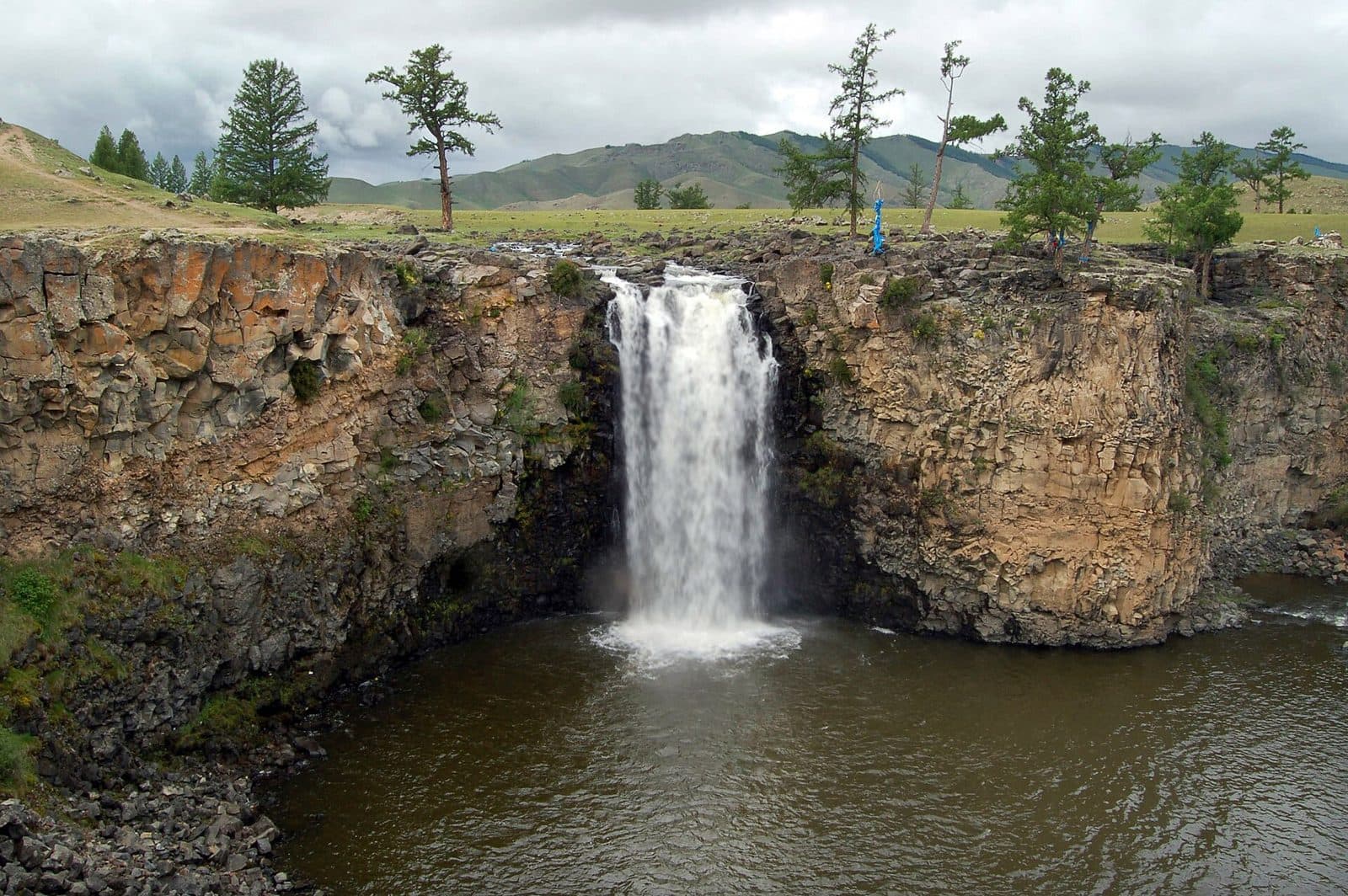
Today is the longest drive of the trip, about 340 km and 8 hours on dirt roads, as the desert gives way to the green hills and river valleys of Central Mongolia. More than 25 m high and 10 m wide, Orkhon Waterfall is the biggest waterfall in the country and one of the most beautiful sights of the Orkhon Valley, a UNESCO World Heritage site. The land around it was shaped by volcanic eruptions about 20,000 years ago and lies under a lava layer more than 10 m thick. After dinner, take a refreshing walk to the falls. You'll hear it before you see it, as the sound of tumbling water fills the valley.
Orkhon Waterfall → Tsenkher Hot Springs
After breakfast, drive about 95 km (2 hours on dirt roads) to Tsenkher Hot Springs, the most famous hot spring in Mongolia and one of Central Mongolia's most popular attractions. Its mineral-rich water comes out of the ground at a perfect 36–40°C. Tsenkher has become so popular that it can be busy in high season, but tonight you stay at a tourist ger camp with its own open-air hot spring pool, so you can relax in the warm water through the evening and under the stars.
Tsenkher → Karakorum (Kharkhorin)
After breakfast, drive about 125 km (3 hours, mostly on a paved road) to Karakorum, the capital of the Great Mongol Empire, where a small township stands today. After the city was sacked, builders reused materials from its ruins to found Erdene Zuu Monastery in 1586, the first Buddhist monastery in Mongolia, ringed by a wall topped with 108 white stupas. Visit Erdene Zuu, the Karakorum Museum, and the other historical sights around the town.
Karakorum → Khustai National Park → Ulaanbaatar
After breakfast, drive about 300 km (5 hours on a paved road) to Khustai National Park, where takhi wild horses have been reintroduced since 1992. Known in the West as Przewalski's horse, the takhi is the last wild horse subspecies to survive into the 21st century. Russian explorer N. M. Przhevalsky first described it in western Mongolia in the late 1870s, but it died out in the wild and survived only in zoos, until breeding programs brought it back to the Mongolian steppe. Stop at the park's research center, then drive deeper into the park to look for and photograph the wild horses. After dinner, drive about 75 km (2 hours, mostly on a paved road) back to Ulaanbaatar, arriving at your accommodation at around 19:00.