
8-Day Central & North Overland Loop to Khuvsgul
Day-by-Day Itinerary
Ulaanbaatar → Khustai National Park → Elsen Tasarkhai Sands
We pick you up from your accommodation and drive about 100 km (2 hours on a paved road) to Khustai National Park, where takhi wild horses have been reintroduced since 1992. Known in the West as Przewalski's horse, the takhi is the last wild horse subspecies to survive into the 21st century. Russian explorer N. M. Przhevalsky first described it in western Mongolia in the late 1870s, but it later died out in the wild and survived only in zoos until breeding programs returned it to the Mongolian steppe. Spend time hiking in the surrounding hills to find the wild horses, and with luck you may also spot maral (red) deer and other wildlife. Then drive about 225 km (4 hours on a paved road) to Elsen Tasarkhai, whose name means 'a piece of sand.' This narrow strip of dunes, often called the northern edge of the Gobi, runs through the lowland between the legendary Khugnu Khan and Bat Khan mountains. On arrival, enjoy dinner in a nomadic family's ger and join in daily herding life, then take a one-hour ride on two-humped Bactrian camels, which walk slowly and gently while you sit comfortably between their humps.
Karakorum (Kharkhorin) → Tsenkher Hot Springs
After breakfast, drive about 75 km (1 hour on a paved road) to Karakorum, the capital of the Great Mongol Empire, where a small township stands today. Some two centuries after the city was sacked by Chinese armies, builders reused materials from its ruins to found Erdene Zuu Monastery in 1586, the first Buddhist monastery in Mongolia, enclosed by a wall topped with 108 white stupas. Visit Erdene Zuu, the Karakorum Museum, and other historical sights around the town, including the ancient granite turtle that once marked the city's boundary. Then drive about 125 km (2 hours on a paved road) to Tsenkher Hot Springs, the most famous hot spring in Mongolia and one of Central Mongolia's most popular attractions. Its mineral-rich water rises at a perfect 36–40°C, and it can be busy in high season. Tonight you stay at a tourist ger camp and relax in its open-air hot spring pool through the evening. If you'd like to add Tuvkhun Monastery and Orkhon Waterfall, the itinerary can be extended by one day; just ask when you enquire.
Tsenkher → Khorgo-Terkh National Park
After breakfast, drive about 215 km (4 hours on a paved road) to Khorgo-Terkh National Park. When the Khorgo volcano erupted in the Quaternary period, its lava dammed a river and created a truly remarkable landscape: the extinct Khorgo crater and Terkhiin Tsagaan ('White') Lake, a large, placid lake ringed by sandy beaches. The park holds 13 complete and partial volcanic cones, lava caves and small circular gorges such as Shar Nokhoin Tam and the Solo Person's Cave, plus striking rock formations, fast-flowing rivers, and cascades. Climb to the rim of the Khorgo crater, where the panoramic view over the lava fields and lake is superb, and walk to explore the surrounding gorges before settling in for the night near the lake.
Khorgo-Terkh → Shine-Ider
After breakfast, set off north on a full travel day to the Shine-Ider district of Khuvsgul province, about 170 km and 6 hours on dirt roads. The road leaves the volcanic landscapes of Arkhangai behind and climbs through rolling forest-steppe, where herders' gers dot the valleys and yaks graze on the slopes. On the way, you cross the high, picturesque Orookh mountain pass, a good place to stretch your legs and take in wide views across the mountains. This is a quieter, less-visited corner of the country, and the slow, bumpy drive is a chance to see everyday rural life far from the main tourist routes. Spend the night in Shine-Ider.
Shine-Ider → Lake Khuvsgul: Horse Ride & Reindeer Herders
After breakfast, drive about 230 km (6 hours, mostly on a paved road) to Lake Khuvsgul. Roughly midway along the border between Mongolia and Russian Siberia, in a vast stone basin nearly 110 km long and almost 40 km wide, lies about 3% of all the fresh water on Earth. Khuvsgul is Mongolia's largest freshwater lake, often called the 'younger sister' of Lake Baikal, and its clear water is framed by larch-covered mountains. Here you ride horses for about 2 hours along the shore and up the mountainside for a sweeping view of the lake; no riding experience is needed. Then meet the reindeer people, Tuvan herders who moved into Mongolia's far north from the Tuva Republic around the 1920s. Some families bring their reindeer down to the lakeshore to sell handmade souvenirs to visitors, giving you a rare chance to meet them and their animals.
Lake Khuvsgul → Uushig Deer Stones → Uran Extinct Volcano
After breakfast, drive about 145 km (3 hours, mostly on a paved road) to the Uushig Valley, home to a complex of 30 deer stones and burial mounds more than 3,000 years old. Carved from long granite blocks, the stones carry stylized flying deer and reflect the Bronze Age funeral practices, sacrificial rituals, beliefs, and animal-style art shared by the region's ancient nomads; they are among the finest examples in Mongolia. After lunch, continue about 310 km (6 hours on a paved road) to Uran extinct volcano. 'Uran' means 'artistic,' a name the Mongols gave because its perfectly round crater looks like the work of a skilled craftsman. The circular ridge is about 500 m across and holds a small crater lake some 20 m wide and 1.5 m deep, and the neighboring Tulga, Jalavch, and Togoo volcanoes, with their broken craters, are easy to recognize nearby. Climb to the top of the volcano for the view.
Uran Volcano → Amarbayasgalant Monastery
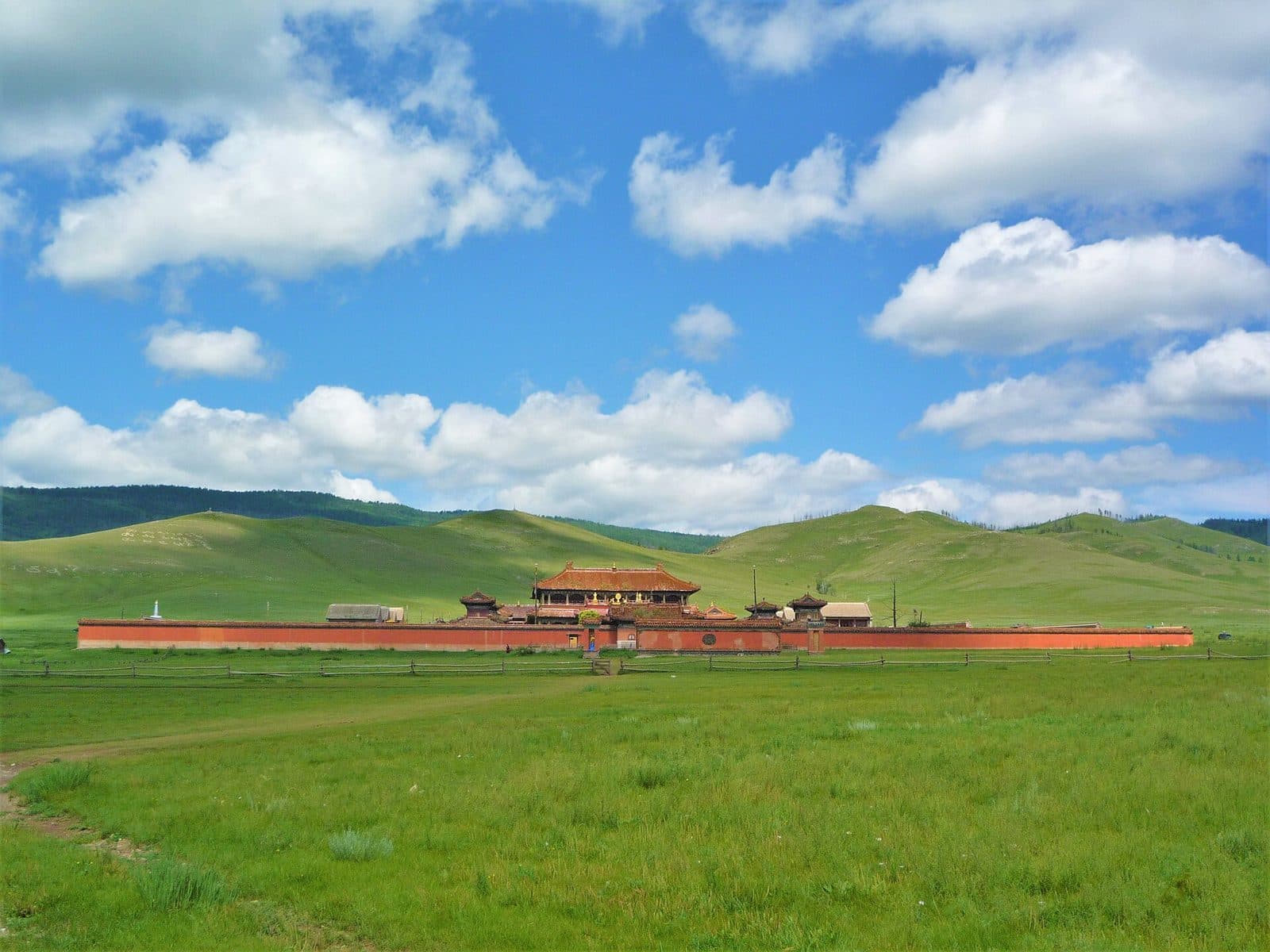
After breakfast, drive about 260 km (4 hours on a paved road) to Amarbayasgalant Monastery, the 'Monastery of Tranquil Felicity,' one of the largest and best-preserved monasteries in Mongolia. It was built in 1736 by order of the Qing emperor to honor Zanabazar, the first Bogd (spiritual head) of Mongolian Buddhism and a renowned sculptor, and its symmetrical layout of temples in a quiet valley of the Selenge region is a masterpiece of Buddhist architecture. The monastery was sacked in 1937 during the Stalinist purges, but restoration that began in 1988 has gradually returned the complex to its former glory. Today it is both an active monastery and a museum. Walk through the courtyards and temples to explore the site, then spend the night nearby.
Amarbayasgalant → Ulaanbaatar
After breakfast, drive back to Ulaanbaatar, about 330 km and 6 hours on a paved road, as the forested hills of the north give way to the open steppe around the capital. It's a good chance to look back through your photos and reflect on a week that took you from wild horses and volcanoes to the shores of Lake Khuvsgul. On arrival in the city at around 15:00, we drop you off at your accommodation.