
6-Day Orkhon Valley & White Lake
Day-by-Day Itinerary
Ulaanbaatar → Khustai National Park → Elsen Tasarkhai: Camel Ride
We pick you up from your accommodation at 08:00 and drive about 100 km (2 hours on a paved road) to Khustai National Park, where takhi wild horses have been reintroduced since 1992. Known in the West as Przewalski's horse, the takhi is the last wild horse subspecies to survive into the 21st century; Russian explorer N. M. Przhevalsky first described it in western Mongolia in the late 1870s. Spend some leisurely time hiking in the hills to look for the horses, and with luck you may also see maral deer and other animals. Then drive about 225 km (4 hours on a paved road) to Elsen Tasarkhai, whose name means 'a piece of sand.' Considered the northern edge of the Gobi, this ribbon of small dunes runs along the lowland below the legendary Khugnu Khaan and Bat Khaan mountains. On arrival, have dinner in a nomad family's ger and join in their daily activities. Then ride Bactrian camels for an hour: they walk slowly and gently, and you sit comfortably supported between their two humps.
Elsen Tasarkhai → Orkhon Waterfall: Horse Ride
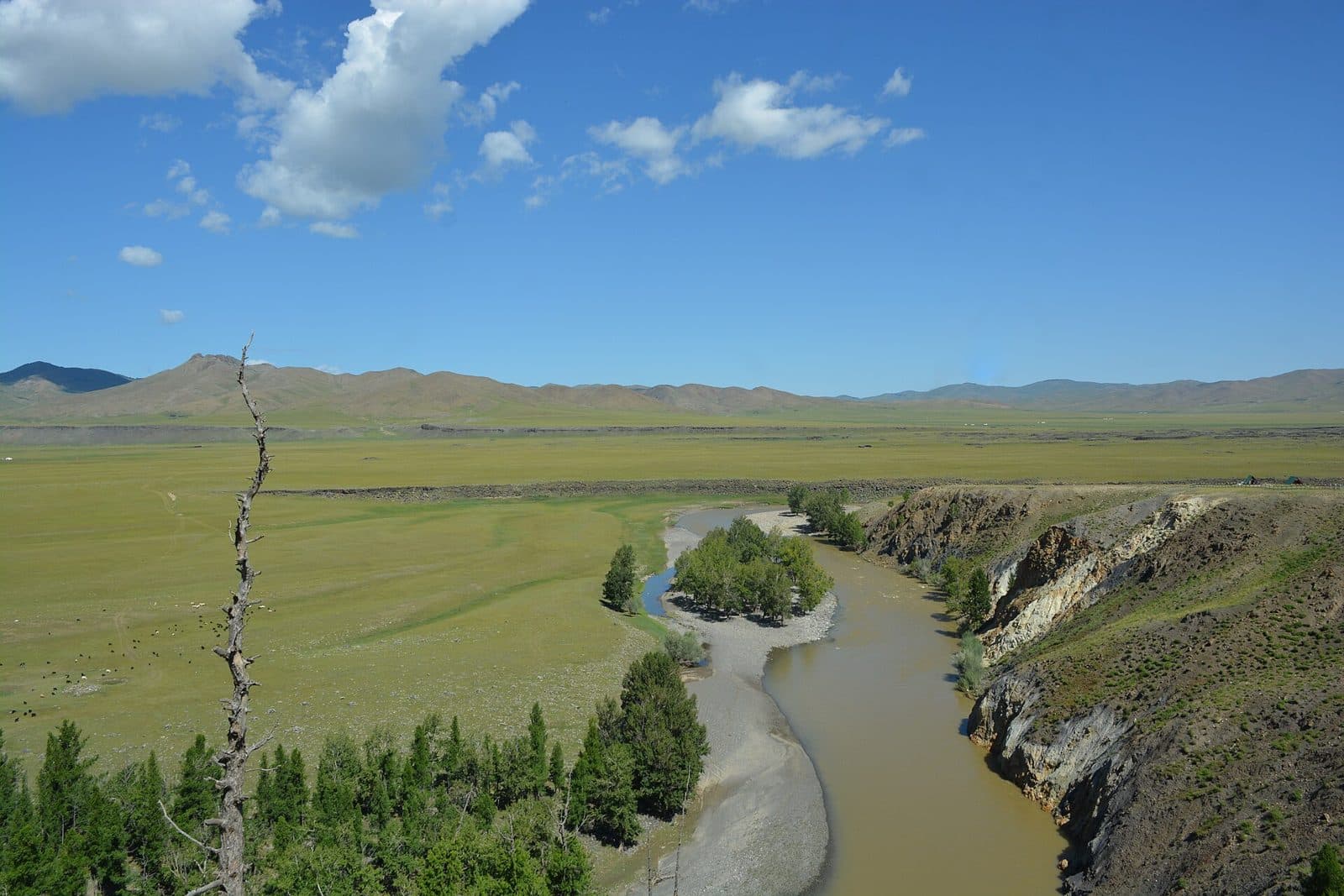
After breakfast, drive about 170 km (4 hours on dirt roads) to Orkhon Waterfall. More than 25 m high and 10 m wide, it is the biggest waterfall in the country and one of the most beautiful sights of the Orkhon Valley, a UNESCO World Heritage site whose pastures have been grazed by nomadic herders for millennia. The land around it was shaped by volcanic eruptions about 20,000 years ago and lies under a lava layer more than 10 m thick, through which the river has carved a deep gorge. After lunch, ride horses through the Ulaan River valley and up the mountain for a view over the sights and sounds of nature. No riding experience is required. Later, take a refreshing walk to the falls. You'll hear it before you see it, as the sound of tumbling water fills the valley.
Tuvkhun Temple → Tsenkher Hot Springs
After breakfast, drive about 60 km (2 hours on dirt roads) to Tuvkhun Temple, perched at about 2,000 m on the summit of Shiveet, a densely forested and picturesque mountain. It was built in 1653 by followers of Zanabazar, the first Bogd, or head of Mongolian Buddhism, as a place for meditation and an art studio. Among the things to see are meditation caves, Zanabazar's footprint in the rock, and the first drawn version of the Soyombo, the symbol of Mongolian independence. Hike from the foot of the mountain up to the temple. After lunch, drive about 120 km (3 hours on dirt roads) to Tsenkher Hot Springs, the most famous hot spring in Mongolia and one of Central Mongolia's most popular attractions. Its mineral-rich water comes out of the ground at a perfect 36–40°C. It can be busy in high season, but tonight you stay at a tourist ger camp with its own open-air hot spring pool, so you can soak through the evening.
Tsenkher → Khorgo-Terkh National Park
After breakfast, drive about 215 km (4 hours on a paved road) to Khorgo-Terkh National Park. Khorgo erupted in the Quaternary Period, and its lava blocked the course of a river. The result of that meeting is a truly incredible landscape: the extinct Khorgo volcano and Terkhiin Tsagaan Lake, a large, placid lake ringed by sandy beaches at more than 2,000 m above sea level. The park holds a number of small and large circuit gorges, such as Shar Nokhoin Tam and the Solo Person's Cave, along with 13 fully or partly erupted volcanoes and rock formations cut by fast-flowing rivers and cascades. Climb to the top of the volcano for a superb panoramic view over the crater and the black lava field, then walk out to discover the gorges. Spend the night near the lake.
Khorgo-Terkh → Karakorum (Kharkhorin)
After breakfast, drive about 300 km (5 hours on a paved road) to Karakorum, the capital of the Great Mongol Empire, where a small township stands today. Chinggis Khaan chose the site in 1220, and under his son Ögedei it grew into a cosmopolitan city visited by merchants and envoys from Europe and Asia. Some two centuries after the city was sacked, builders reused materials from its ruins to found Erdene Zuu Monastery in 1586, the first Buddhist monastery in Mongolia, ringed by a wall topped with 108 white stupas. Visit Erdene Zuu, the Karakorum Museum with its finds from the ancient city, and the other historical sights around the town. Spend the night nearby.
Karakorum → Ulaanbaatar
After breakfast, drive about 360 km (6 hours on a paved road) back to Ulaanbaatar across the rolling steppe of Central Mongolia, with time to watch the herds of horses, sheep, and goats along the way and look back through your photos. On arrival in the city, we drop you at your accommodation at around 15:00.